AZAL
AZAL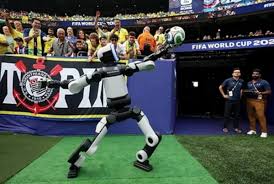
In a moment that looked straight out of a science fiction movie, Atlas, the advanced humanoid robot developed by Boston Dynamics, captured global attention during the 2026 FIFA World Cup. While tens of thousands of fans filled the stadium and millions watched worldwide, Atlas made a memorable appearance before the second half of the Round of 16 match between Brazil and Norway.
Standing on the edge of the pitch, the nearly two-meter-tall robot confidently performed football celebrations inspired by some of the sport’s biggest stars before walking toward the referee and handing over the match ball, drawing applause and amazement from spectators.
Although the demonstration lasted only a few seconds, it showcased years of progress in robotics, artificial intelligence, and machine learning.
More Than a Public Demonstration
Atlas’ appearance marked one of the robot’s largest public showcases since Boston Dynamics, now owned by Hyundai Motor Group, introduced its next-generation humanoid platform.
For years, Boston Dynamics has been known for videos of Atlas running, jumping, performing backflips, and executing highly dynamic movements. Today, however, the company’s focus has shifted beyond entertainment demonstrations toward building robots capable of performing practical industrial tasks alongside human workers.
A Completely Redesigned Atlas
The current Atlas is far more than an upgraded version of its predecessor.
In April 2024, Boston Dynamics officially retired its iconic hydraulic-powered Atlas after more than a decade of research and replaced it with an entirely new electric platform designed specifically for real-world industrial applications.
Moving from hydraulic systems to electric actuators offers several advantages, including improved energy efficiency, quieter operation, lower maintenance requirements, and greater long-term reliability.
The robot has also been redesigned with joints capable of rotating far beyond normal human limits, allowing Atlas to perform movements that may appear unusual but are highly effective in industrial environments.
Built for Strength and Precision
Atlas features 56 independent degrees of freedom, enabling exceptional balance, flexibility, and precise motion control.
Its robotic arms provide an approximate 2.3-meter reach, while the system is capable of lifting loads of up to 50 kilograms.
Beyond its physical capabilities, Atlas combines advanced mobility with artificial intelligence, allowing it to make real-time decisions while handling objects, avoiding obstacles, and adapting its movements to changing environments.
Another notable innovation is its ability to replace its own battery autonomously, reducing downtime and enabling longer continuous operation inside factories and warehouses.
How Atlas Learns
One of Atlas’ most advanced features is its AI-driven training process.
Instead of relying entirely on traditional programming, the robot learns through simulation and experience, much like modern AI models.
Training begins with motion-capture recordings of real human movements, which are transferred into advanced virtual simulation environments. Inside these digital worlds, Atlas performs millions of simulated attempts within hours, encountering obstacles, unexpected situations, and deliberate errors.
Through reinforcement learning, the robot continuously improves its ability to adapt, eventually developing something similar to human “muscle memory,” allowing it to perform complex movements smoothly without recalculating every action in real time.
From Football Stadiums to Factory Floors
While Atlas’ World Cup appearance attracted worldwide media attention, Boston Dynamics’ primary objective lies far beyond sports events.
The humanoid robot is currently being tested inside Hyundai manufacturing facilities, where it performs tasks such as handling components, organizing parts, and transporting materials across production lines.
Hyundai believes humanoid robots will become an essential part of future manufacturing, particularly in jobs requiring flexibility and mobility beyond the capabilities of conventional robotic arms or fixed automation systems.
The company is also investing heavily in expanding humanoid robot production in the United States, with plans to manufacture tens of thousands of Atlas units annually during the second half of this decade.
A Global Race in Humanoid Robotics
Boston Dynamics is no longer alone in the race to commercialize humanoid robots.
The company now faces growing competition from Tesla with Optimus, Figure AI, backed by Microsoft, NVIDIA, and OpenAI, whose robots are already being tested in BMW factories, as well as Agility Robotics and several emerging startups.
Despite increasing competition, Boston Dynamics continues to hold a significant advantage thanks to decades of expertise in dynamic motion, balance, and autonomous navigation—technologies that have helped Atlas become one of the world’s most advanced humanoid robots.
Vexiora Analysis
Atlas’ appearance at the 2026 FIFA World Cup was more than a carefully choreographed demonstration—it reflected how rapidly humanoid robotics is moving from research laboratories into real-world applications. Public events help showcase the technology, but the true value of robots like Atlas lies in manufacturing, logistics, and other industries facing growing labor shortages and increasing automation demands.
As artificial intelligence continues to advance, humanoid robots are expected to become more capable of working safely and efficiently alongside humans. Companies such as Boston Dynamics, Tesla, and Figure AI are shaping what could become one of the most transformative technology markets of the coming decade.