AZAL
AZAL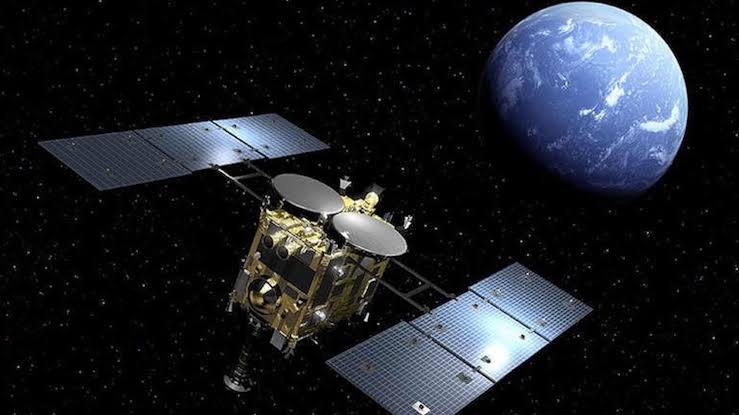
The probe is expected to attempt a landing on an asteroid in 2031 to collect detailed data.
Japan’s Hayabusa2 space probe has successfully completed a close flyby of the near-Earth asteroid Torifune, marking an important step toward developing technologies that could one day help protect Earth from potentially dangerous asteroids.
A Mission Focused on Planetary Defense
The Japan Aerospace Exploration Agency (JAXA) confirmed that Hayabusa2 passed within 800 meters (2,625 feet) of the asteroid’s surface, making it one of the closest flybys ever performed around a near-Earth asteroid.
Unlike missions designed to alter an asteroid’s trajectory, the primary goal of this operation was to test the spacecraft’s ability to navigate with extreme precision while flying near a small celestial body. Mastering this capability is considered essential for future planetary defense missions.
Collecting Valuable Scientific Data
During the flyby, Hayabusa2 used its onboard cameras and scientific instruments to gather detailed information about the asteroid, including:
- Surface geology and terrain
- Physical composition
- Surface temperature
- Structural characteristics
These observations will help scientists better understand near-Earth asteroids and improve future strategies for planetary defense and asteroid exploration.
Building on Previous Success
Hayabusa2 has already earned international recognition for its groundbreaking achievements. Launched in 2014, the spacecraft successfully landed on the asteroid Ryugu, collected rock samples, and safely returned them to Earth, providing researchers with invaluable material for scientific study.
The successful Torifune flyby demonstrates that the spacecraft continues to deliver valuable scientific results long after completing its original mission.
What’s Next for Hayabusa2?
According to JAXA’s mission plan, Hayabusa2 is expected to attempt another close encounter with an asteroid in 2031. The mission could involve either a close flyby or a landing attempt to collect more detailed scientific data, further advancing asteroid exploration technologies.
Why This Mission Matters
Global interest in planetary defense has grown significantly in recent years, especially after NASA’s DART mission successfully changed the orbit of the asteroid Dimorphos in 2022—the world’s first successful asteroid deflection test.
While DART demonstrated that an asteroid’s path can be altered, Hayabusa2 focuses on another critical aspect of planetary defense: precise spacecraft navigation and collecting scientific data that will help scientists better understand the composition and behavior of potentially hazardous asteroids.
Vexiora Analysis
Hayabusa2’s latest achievement highlights the growing international effort to prepare for future asteroid threats. Protecting Earth is not only about developing technologies capable of deflecting asteroids but also about understanding their structure, composition, and movement before any intervention is attempted.
Every successful mission like Hayabusa2’s close flyby of Torifune provides scientists with crucial data that strengthens future planetary defense strategies and improves humanity’s ability to respond to potential space hazards.